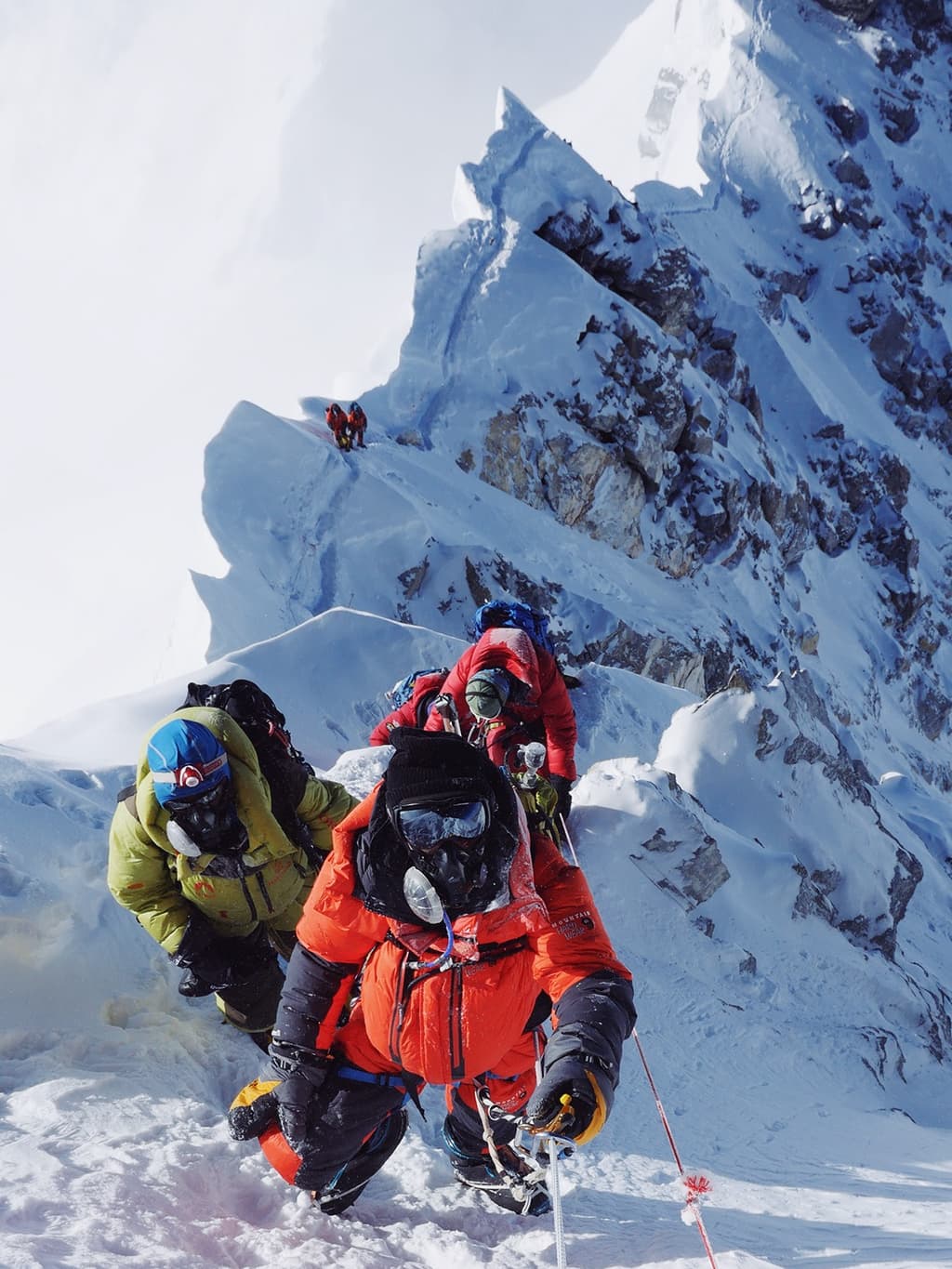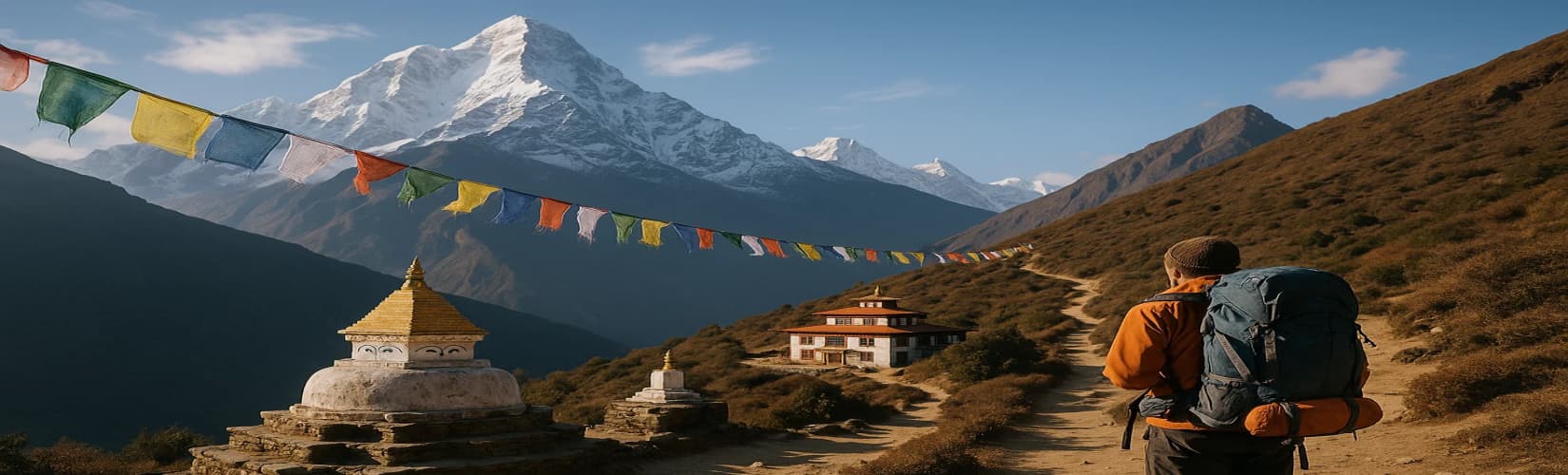
The first light of dawn brushes the Himalayan peaks with hues of gold and rose, casting shadows that dance across glaciers and ridges. In Nepal, mountaineering is not merely a pursuit of summits—it is an invitation to journey inward. Every trail, every icefall, every ridge holds stories of ancient deities, sacred rituals, and timeless wisdom.
Here, adventure and spirituality are inseparable. The towering peaks—Everest, Annapurna, Lhotse—are more than geological marvels; they are living symbols of divinity and resilience. As climbers ascend, they confront not only the elements but also the depths of their own courage, patience, and self-awareness.
In Nepal, the mountains teach lessons that transcend the physical climb. Silence becomes a teacher, snow and wind become guides, and the grandeur of the landscape opens doors to reflection, mindfulness, and spiritual awakening. To climb in these sacred spaces is to experience nature in its purest form, to understand life on a profound level, and to discover a connection to the universe that endures long after the summit has been reached.
At Everest Sherpa Expeditions, we understand that a Himalayan expedition is more than just reaching a peak. It's a journey into the soul of Nepal, an experience woven with ancient traditions, sacred landscapes, and a quiet spirituality that permeates every step. This blog post explores the elements that transform a high-altitude trek into a truly spiritual expedition.
The Cultural Landscape of Nepal: A Tapestry Woven with Devotion

Nepalese Culture and Traditions
Nepal is a mosaic of ethnicities, languages, and customs. Festivals like Dashain, Tihar, and Losar are celebrated with fervor, reflecting a deep sense of community and spiritual devotion. Local architecture, from intricately carved temples to stone shrines, mirrors the country’s reverence for the sacred. Even daily life in villages is infused with ritual—people begin their mornings with prayers and offerings, embodying a culture where spirituality permeates the mundane.
The Role of Spirituality in Nepalese Life
Spirituality in Nepal is not confined to formal religious practice. It is a way of life. Mountains, rivers, and forests are seen as living embodiments of divine energy. Respect for these natural entities is central to Nepalese culture. Villagers often offer food, flowers, or incense to spirits residing in sacred landscapes, reflecting an understanding that humans are part of a larger cosmic order.
Major Religions in Nepal
Nepal is predominantly Hindu, with Buddhism as a close second. Hinduism venerates mountains as abodes of deities—Everest is called Sagarmatha, “Forehead of the Sky,” and believed to be home to gods. Buddhism emphasizes mindfulness, compassion, and meditation, encouraging climbers to view mountains not just as challenges, but as sacred spaces for reflection and enlightenment. These traditions blend seamlessly into the mountaineering experience, transforming physical endeavors into spiritual pilgrimages.
Sacred Mountains of Nepal: The Abodes of Gods
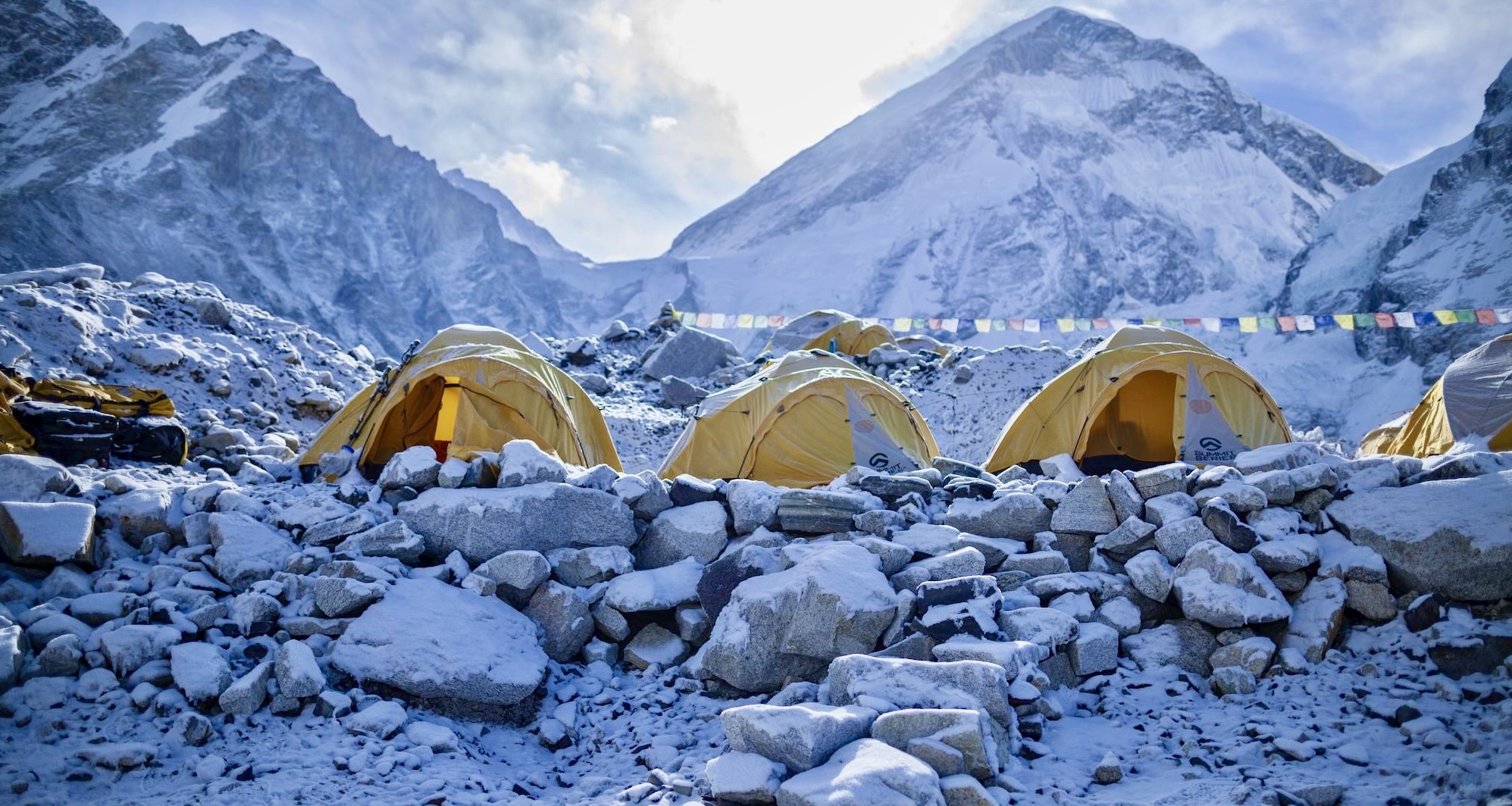
The Nepalese do not look upon the Himalayas as inert geology. These peaks are living deities, central to mythology, religion, and national identity.
Mount Everest – Sagarmatha, the Mother Goddess
Everest is not just the highest peak; it is a deity. The Sherpa people call her Chomolungma, the “Mother Goddess of the World.” Local legends tell of spirits that guard the mountain, and climbers often report a profound sense of being watched over—an invisible hand of protection.
As you approach Everest Base Camp, the trail weaves through prayer flags fluttering like wings of devotion. The icefalls glint in the sun, a frozen cathedral where silence reigns. Climbers often describe a shift from physical exertion to spiritual awareness, where every breath of thin air feels like communion with something far greater than oneself.
Annapurna – The Nourishing Goddess
Annapurna, towering over the Annapurna Circuit, is revered as the goddess of harvest and abundance. Legends speak of her nurturing presence, protecting travelers from hunger and misfortune. Trekking through her valleys, one cannot help but feel held in her care.
The trails are dotted with chortens and mani stones, while remote villages offer glimpses of everyday devotion. Climbers often pause in these sacred spaces, reflecting on gratitude, sustenance, and the invisible forces that sustain life. Annapurna teaches patience: the climb is less about conquering, and more about surrendering to the mountain’s rhythm.
Machapuchare – The Fish Tail, Home of Shiva
Machapuchare’s jagged, twin peaks pierce the sky like Shiva’s trident. Unclimbed and untamed, it stands as a symbol of reverence over ambition. Locals believe it is sacred, and any attempt to scale its summit would anger the gods.
To trek alongside Machapuchare is to feel humility on a visceral level. The sheer cliffs and hidden valleys command respect. Climbers often speak of silent awe, a sense of being a guest in a sacred space rather than a conqueror of nature. It is a lesson in restraint, devotion, and reverence.
Kanchenjunga
The world's third-highest peak, straddling the Nepal-India border, is revered as a guardian deity. Its name means "The Five Treasures of the High Snow," believed to represent the five repositories of God: gold, silver, gems, grain, and holy books. In a powerful tradition of respect, climbing parties historically stopped short of the actual summit to avoid defiling this sacred space.
To know these names and their meanings is to fundamentally alter one's approach to the climb. You are not stepping onto a rock; you are stepping into a sanctuary.
The Journey: The Inner Ascent Mirrors the Outer One
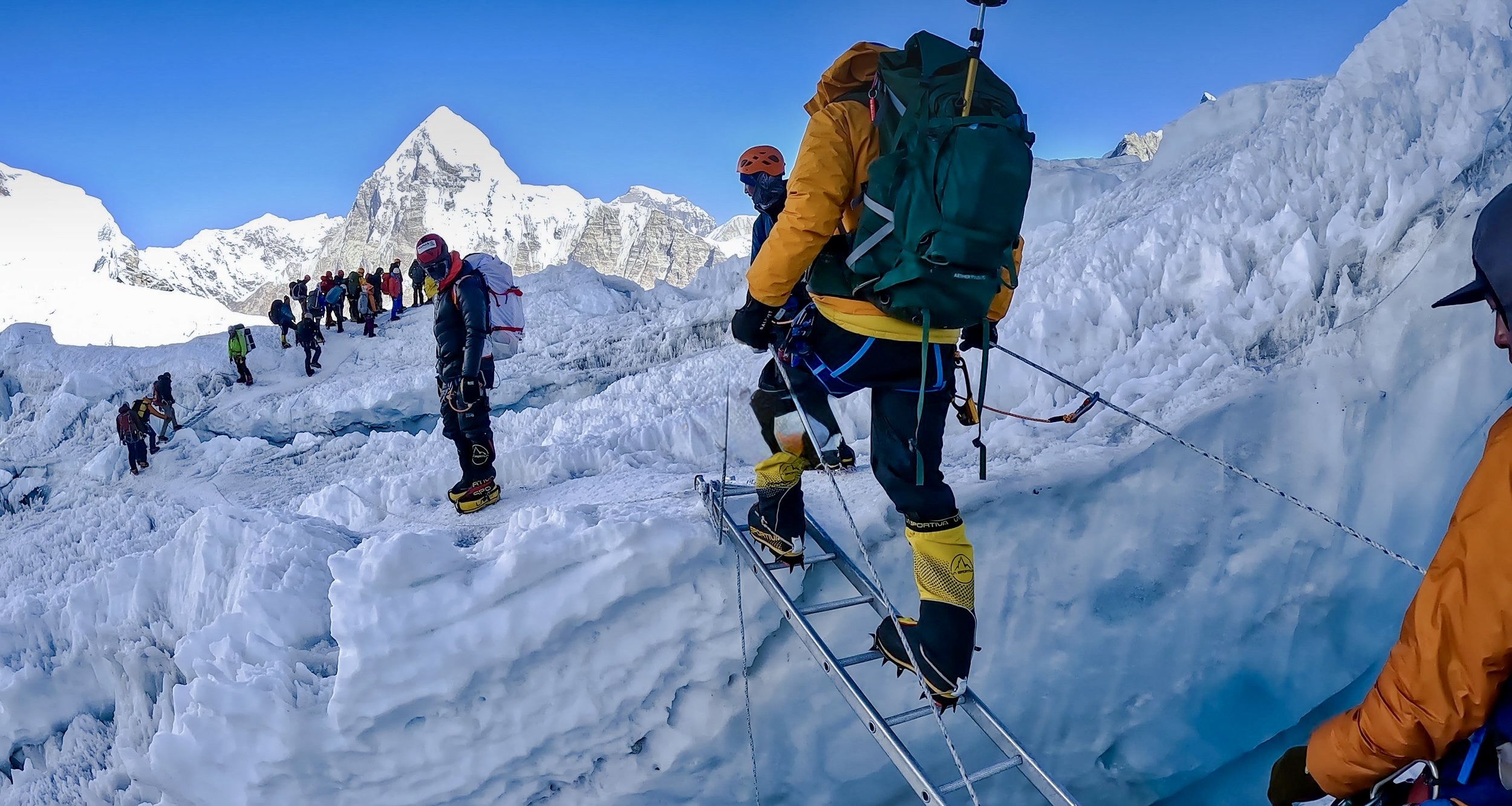
The physical ordeal of high-altitude mountaineering is the crucible in which the spiritual journey is forged. It is an unavoidable and necessary part of the transformation.
Understanding the Brutal Physicality
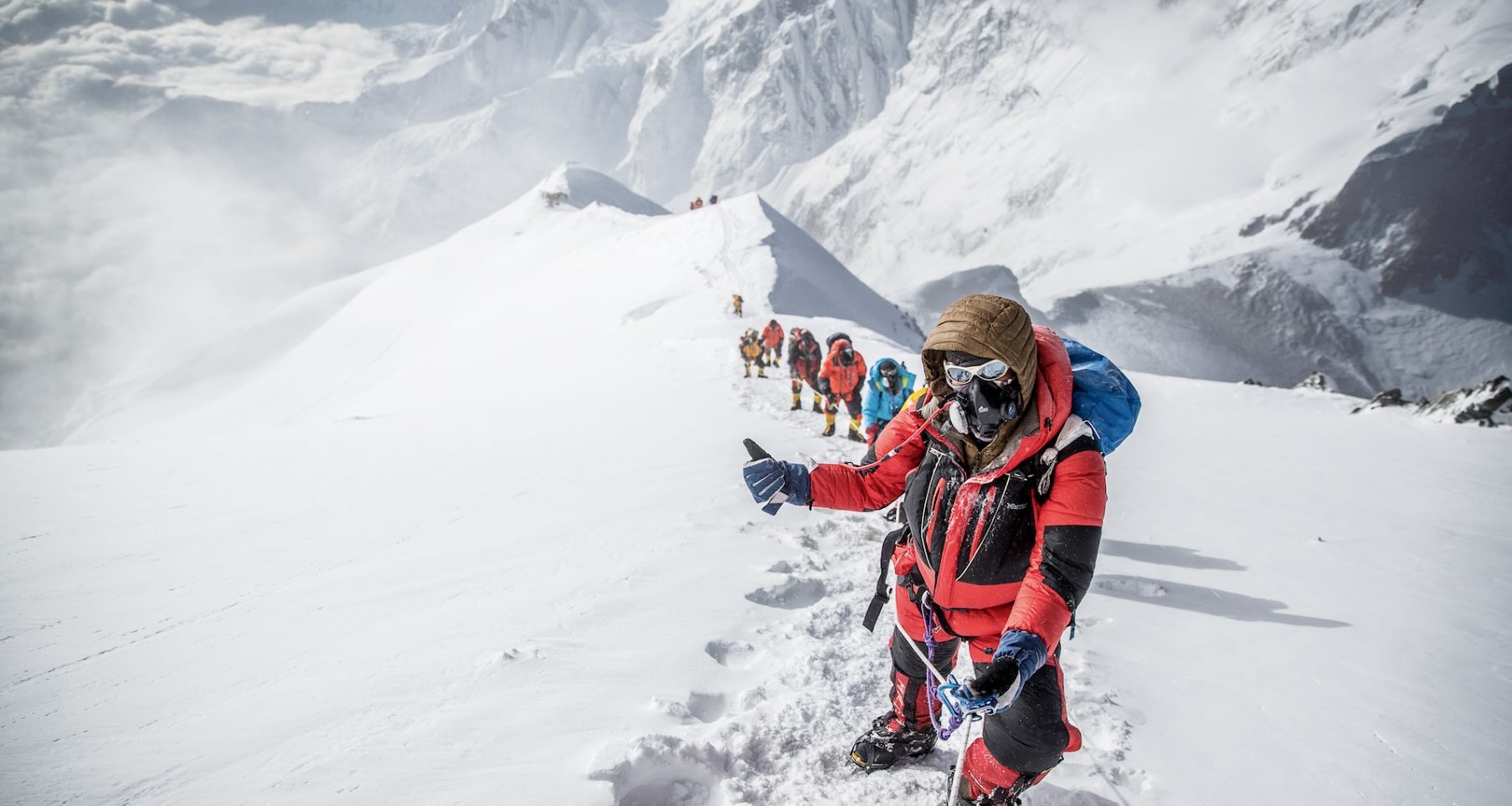
The challenge is absolute. At high altitude, the body is in a constant state of crisis. Oxygen deprivation (hypoxia) leads to headaches, nausea, and a debilitating fatigue that seeps into your bones. Every step with a 20kg pack on a 40-degree ice slope at 6,000 meters requires a Herculean effort of will. The cold is invasive, the sun is punishing, and the terrain is relentlessly unstable. This suffering serves a spiritual purpose: it systematically dismantles the ego. Your job title, social status, and worldly possessions become meaningless. You are reduced to your most primal state—a vulnerable being focused solely on survival, on the next breath, the next step.
The Landscape of Inner Reflection
Paradoxically, this physical stripping away creates mental and emotional space. The monotonous rhythm of climbing—the crunch-thump of your crampons, the steady hiss of your breath through an ice-clogged regulator—becomes a mantra. The digital noise of modern life is replaced by the roaring silence of the mountains. In this vast emptiness, you are forced to confront yourself.
-
Confronting Fear: The fear of falling, of avalanche, of failure, is ever-present. Acknowledging this fear, sitting with it, and learning to move forward in spite of it is a profound spiritual practice.
-
Ultra-Present Awareness: The mountain demands absolute focus. A misplaced foot or a missed clip-in can be fatal. This forces you into a state of hyper-awareness, where the past and future fall away, and you exist entirely in the present moment—a state that many meditators spend years trying to achieve.
-
Humility and Interdependence: The mountain constantly reminds you of your insignificance and your dependence on others. You rely on your Sherpa guides, your teammates, the weather, and the mountain's mercy. This fosters a deep sense of humility and connection.
Rituals and Practices: Honoring the Sacred Path

The spirituality of the climb is not abstract; it is enacted through powerful, tangible rituals that bind the team to the mountain and to each other.
The Puja Ceremony: Seeking Permission
Before any climb begins, every expedition gathers at Base Camp for a puja ceremony, conducted by a Buddhist lama and the Sardar (head Sherpa). A stone altar is built and adorned with offerings: rice, biscuits, candy, and chang (local barley beer). Prayers are chanted, asking the mountain deity (Yul Lha) for safe passage and forgiveness for the intrusion. The climbers’ gear—ice axes, crampons, harnesses—is placed before the altar to be blessed. The ceremony concludes with a joyful celebration of sharing food and drink. It is a profound, humbling ritual that redefines the mission: you are not a conqueror but a humble guest requesting entry.
The Language of the Landscape: Prayer Flags and Mani Walls
As you ascend, the path is marked by spiritual signposts.
-
Prayer Flags (Lungta): These colorful panels, strung across passes and high points, are covered in sacred mantras and prayers. Each color—blue (sky/space), white (air/wind), red (fire), green (water), yellow (earth)—represents an element. It is believed that the wind, as it moves through the flags, carries the blessings and compassion of the prayers out into the universe, benefiting all beings. They are a beautiful visual metaphor for the interconnectedness of all life.
-
Mani Walls: These are long, chest-high structures made of thousands of stone slabs, each meticulously carved with the Tibetan Buddhist mantra "Om Mani Padme Hum." The custom is always to pass these walls to their right, circling them as you would a stupa, in a clockwise direction. They transform the trail into a sacred pathway.
The Sherpa: Spiritual Guides as Much as Mountain Guides
The Sherpa people are the soul of Himalayan mountaineering. Their role transcends that of a logistical expert or high-altitude porter. They are cultural and spiritual interpreters.
Their deep-rooted Tibetan Buddhism informs a worldview based on compassion (karuna), non-harm (ahimsa), and respect for all living things. Their strength is coupled with a profound humility and acceptance of the mountain's will. Climbing alongside them is a masterclass in a different way of being—one that values community, karma, and harmony with nature over individual triumph. Their quiet confidence and reverence are a constant, grounding influence.
The Role of Nature: The Ultimate Spiritual Teacher
In the Himalayas, nature is not a scenic backdrop; it is the primary instructor in spiritual enlightenment.
Impermanence (Anicca): The mountain teaches this core Buddhist principle every day. Serene blue skies can morph into a life-threatening storm in minutes. Glaciers calve, trails vanish under fresh snow, and avalanches reshape landscapes. You learn that nothing is fixed, and clinging to expectation is a source of suffering. The only constant is change.
Humility and Awe: The sheer scale and power of the environment—the deafening roar of an icefall, the breathtaking vista from a high pass—overwhelm the senses. This experience of awe directly diminishes the ego and creates a feeling of being part of something infinitely vast and beautiful, a concept often referred to as a "self-transcendent experience."
Testimonials: Stories from Climbers
"I went to Everest Base Camp expecting a physical challenge, but what I found was a spiritual journey. The sheer scale of the mountains and the profound serenity of the monasteries changed my perspective on everything." – Jessica P., USA
"The puja ceremony before our climb was an incredibly moving experience. It wasn't about conquering the mountain; it was about asking for permission to be there. It put my ego in check and made the entire experience so much more meaningful." – David L., UK
"My Sherpa guide taught me so much about patience and gratitude. His respect for the mountain and his deep faith inspired me. I came back a better person." – Sarah M., Australia
Personal Accounts
Many climbers report profound spiritual awakenings. One climber described an intense sense of peace at the base of Annapurna, feeling “as if the mountains themselves were teaching patience and surrender.” Another spoke of tears and gratitude while standing beneath Everest, overwhelmed by its magnitude and silent majesty.
Reflections on Transformation
The spiritual impact of Himalayan climbs often persists long after the journey ends. Climbers carry lessons of resilience, mindfulness, and humility into their daily lives, finding new perspectives on personal challenges and relationships.
Shared Spirituality
The bonds formed between climbers and Sherpas create a communal spiritual experience. Shared prayers, rituals, and silent moments on treks reinforce a collective respect for the sacredness of the mountains and a shared journey toward self-realization.
How to Embrace the Spiritual Journey on Your Climb
You don't need to be a Buddhist monk to connect with the spiritual dimension of the Himalayas. Here’s how you can open yourself to the experience:
- Climb with Intention: Set an intention for your climb beyond reaching the summit. It could be gratitude, healing, or simply being fully present.
- Practice Silence: Take hours during your trek or climb to walk in silence. Listen to the sound of the wind, your breath, and the inner voice that is so often drowned out.
- Learn the Stories: Ask your guides about the local legends, the names of the mountains, and their significance. Understanding the cultural context deepens the experience immeasurably.
- Leave No Trace: This is a practical and spiritual act. Respect the sanctity of the mountain by leaving it pristine. It is an offering of thanks.
- Embrace the Challenges: The difficult moments—the cold, the fatigue, the fear—are where the most growth happens. Meet them not with resistance, but with curiosity and a willingness to learn.
Mountaineering in Nepal is far more than a test of physical endurance—it is a journey into the soul. The Himalayas, with their towering peaks and serene valleys, offer a unique space where adventure meets introspection, and every step forward is also a step inward. Climbers discover that the mountains are not just obstacles to overcome, but teachers of patience, humility, and inner strength.
In the quiet of the high ridges, the flutter of prayer flags, and the shadow of sacred peaks, one encounters moments of clarity and connection that transcend the ordinary. The challenges of the climb—the biting cold, thin air, and steep ascents—become catalysts for self-discovery, revealing resilience, courage, and a deeper appreciation for the natural world.
Ultimately, the spiritual side of mountaineering in Nepal reminds us that the greatest summit is not the peak itself, but the inner transformation it inspires. Every trek, every climb, and every ritual along the way invites reflection, mindfulness, and a sense of unity with the universe. For those who venture into these sacred landscapes, Nepal’s mountains offer an enduring gift: the chance to explore not just the heights of the Himalayas, but the depths of the human spirit.
If you need any further information, please contact us by email: [email protected], Phone: +977- 980 195 6248 (WhatsApp).